
General ERP & Manufacturing
Straightforward answers to the questions manufacturers ask most often when evaluating, implementing, and running ERP software.
-
What is ERP for manufacturing?
ERP (Enterprise Resource Planning) for manufacturing is software that connects every part of a production operation, from quoting and order entry through scheduling, purchasing, shop floor execution, and shipping, into a single system. Instead of managing work in disconnected spreadsheets or standalone tools, a manufacturing ERP gives everyone access to the same up-to-date information so decisions are based on real data rather than guesswork.
IndustriOS ERP is built specifically for discrete and custom manufacturers, covering inventory, production, material planning, sales, and time tracking in one integrated suite.
-
What ERP works best for make-to-order manufacturing?
A make-to-order (MTO) manufacturer needs an ERP that can handle unique job configurations, accurate job costing, and flexible scheduling without forcing every order through a rigid production template. The best-fit systems let you manage engineer-to-order complexity while still supporting repetitive or hybrid make-to-stock runs when needed.
IndustriOS ERP is designed for custom manufacturing environments, including make-to-order with hybrid make-to-stock capabilities, so you can handle diverse order types within a single system.
-
What is the difference between make-to-order and make-to-stock ERP?
Make-to-stock (MTS) ERP focuses on forecasting demand, building inventory ahead of orders, and managing reorder points. Make-to-order (MTO) ERP focuses on managing unique jobs, tracking costs per order, and scheduling production based on customer-specific requirements. Many manufacturers operate in a hybrid mode, carrying some standard inventory while also filling custom orders, and need an ERP that supports both workflows without workarounds.
IndustriOS addresses hybrid environments directly, giving manufacturers the flexibility to switch between make-to-order and make-to-stock processes depending on the product line or customer.
-
What does “discrete manufacturing” mean?
Discrete manufacturing produces distinct, countable items such as machined parts, assembled equipment, or fabricated components. This is different from process manufacturing, which produces things like chemicals or food in bulk batches measured by volume or weight. Discrete manufacturers typically work from bills of materials and routings, and their ERP needs to track individual units, assemblies, and job orders rather than batch recipes.
IndustriOS ERP is purpose-built for discrete manufacturers, with core functionality centered around bills of materials, shop floor routing, and job-level cost tracking.
-
What size of manufacturer is IndustriOS built for?
IndustriOS is designed for small to mid-sized discrete manufacturers who need serious production management capabilities without the overhead and complexity of a Tier 1 enterprise system. It scales as your operations grow and integrates with accounting platforms you may already be running, such as Sage 300, QuickBooks, or Oracle eBusiness Suite.
Job Costing & Financial Visibility
-
How does ERP improve job costing accuracy?
Without ERP, job costing typically involves pulling data from multiple sources after the fact: timesheets here, purchase orders there, inventory counts somewhere else. An ERP captures material, labor, and overhead costs as they happen, directly against the job, so you can see estimated versus incurred costs at any point during production rather than days or weeks after the job ships.
IndustriOS ERP provides real-time job costing visibility across the production line, replacing what was previously a multi-day manual process with instant access to exact cost data.
-
What is the difference between standard costing and incurred
costing in manufacturing?
Standard costing assigns predetermined costs to materials and labor to simplify variance analysis and financial reporting. Incurred costing tracks the real costs on each job as they happen. Most custom manufacturers benefit from incurred costing because every job is different, but some use a blend of both: standard costs for common components and incurred costs for labor and custom materials.
IndustriOS supports job-level cost tracking so manufacturers can see precise costs throughout production, not just after the fact.
-
Can ERP help with quoting accuracy?
Yes. When your ERP contains reliable historical data on material usage, labor hours, and scrap rates, you can base new quotes on what happened on similar past jobs rather than rough estimates. Over time this tightens your margins in the right direction: competitive enough to win work, accurate enough to protect profitability.
IndustriOS captures production data at the job level, giving your estimating team a factual basis for future quotes.
Inventory & Traceability

-
How do manufacturers track inventory traceability?
Traceability means being able to follow a material or component from receipt through production to the finished product it ended up in. Manufacturers typically achieve this through lot tracking, serial number assignment, or a combination of both, all managed within their ERP. This is especially important in regulated industries like aerospace and defense where you need to prove exactly which material went into which unit.
IndustriOS ERP includes inventory management with lot and serial tracking capabilities, supporting full traceability from receiving through shipment.
-
What is cycle counting and why does it matter?
Cycle counting is the practice of counting a small subset of inventory on a rotating basis rather than shutting down to do a full physical count once a year. It keeps inventory records accurate on an ongoing basis, catches discrepancies early, and avoids the disruption and cost of annual wall-to-wall counts. For manufacturers, accurate inventory means fewer production delays from unexpected shortages.
IndustriOS provides inventory management tools that support ongoing cycle counting so you can maintain accuracy without halting production.
-
How does ERP manage raw materials and finished goods in one
system?
A manufacturing ERP maintains a single item master that distinguishes between raw materials, work-in-process, sub-assemblies, and finished goods. Bills of materials define what goes into each product, and as production orders consume raw materials and output finished goods, the system updates quantities across all stages automatically. This eliminates the problem of maintaining separate tracking systems that inevitably fall out of sync.
IndustriOS ERP handles the full lifecycle of inventory, from raw material procurement through production to finished goods, within one unified system.
Production Scheduling & Planning
-
What is MRP in manufacturing?
MRP (Material Requirements Planning) is a calculation that looks at what you need to build, checks what you already have on hand and on order, and tells you what to buy and when to buy it. It works backward from your production schedule and bills of materials to generate purchase and production recommendations. Without MRP, planners end up manually cross-referencing orders, inventory, and lead times, a process that becomes unmanageable as volume increases.
IndustriOS includes Material Planning and Procurement functionality that automates this process, helping manufacturers avoid both shortages and excess inventory.
-
What is an APS system in manufacturing?
APS (Advanced Planning and Scheduling) goes beyond basic MRP by considering capacity constraints like machine availability, labor shifts, tooling, and setup times when building a production schedule. Where MRP tells you what to make, APS tells you when and where to make it given your resource limitations. This matters most in shops running near capacity or managing complex routings across multiple work centers.
IndustriOS ERP includes production scheduling tools designed for discrete manufacturing environments, helping shops plan around real-world capacity constraints.
-
How does ERP help with shop floor data collection?
Shop floor data collection means capturing what is happening in production as it happens: which jobs are running, how long operations take, how much material is used, and what scrap is generated. ERP systems handle this through work order transactions, barcode scanning, or time clock entries tied directly to jobs and operations. This live data feeds job costing, scheduling, and performance analysis.
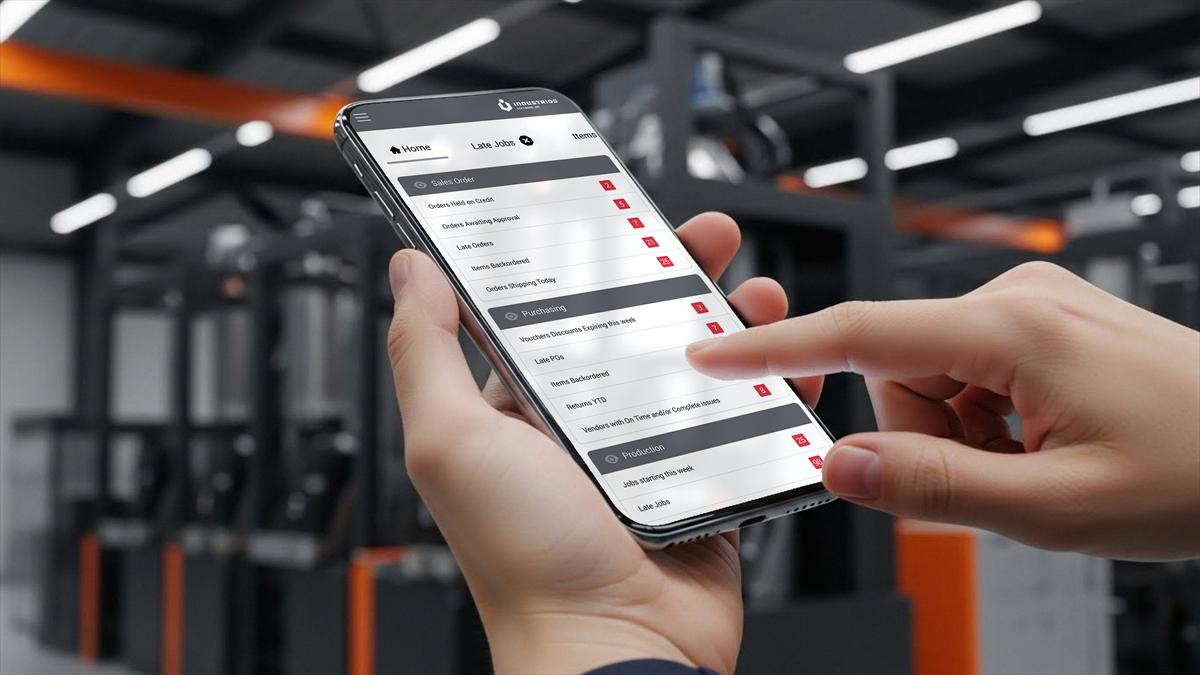
IndustriOS supports shop floor data collection and mobile transactions, giving manufacturers real-time visibility into production status and performance.
-
What is a manufacturing dashboard and why is it useful?
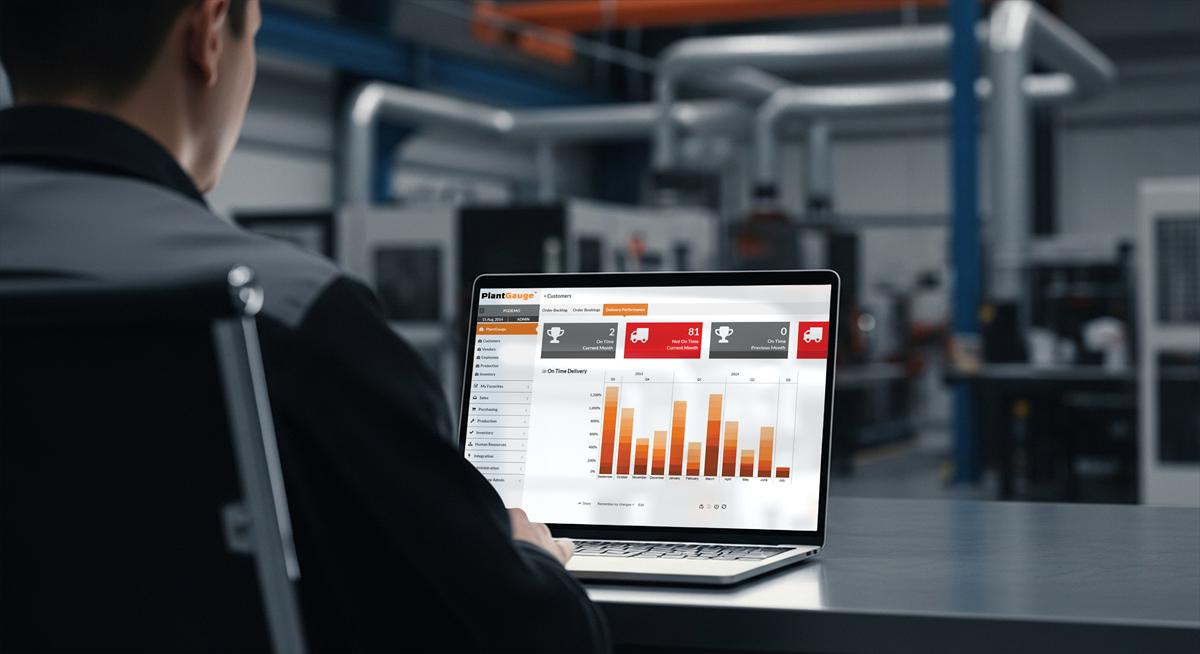
A manufacturing dashboard pulls key metrics like on-time delivery, production throughput, scrap rates, labor efficiency, and open orders into a single visual display that updates in real time or near-real time. Instead of running reports and waiting for data, managers and operators can see how the plant is performing at a glance and spot problems before they compound.
IndustriOS includes PlantGauge, a browser-based manufacturing intelligence dashboard that turns production data into clear, usable information with one-click access to key metrics.
Integrations & Ecosystem
-
What ERP integrates with Sage 300?
Several manufacturing ERP systems offer connections to Sage 300 (formerly Sage Accpac), but the depth of the integration varies widely. The most useful integrations pass transactions between the manufacturing system and Sage 300 automatically (sales orders, purchase orders, inventory movements, AP/AR), so your accounting team continues working in the platform they already know.
IndustriOS ERP integrates directly with Sage 300cloud. Over 40,000 customers across 150 countries trust Sage 300 for financial management, and IndustriOS is designed to work alongside it without requiring a change in your accounting system.
-
Can a manufacturing ERP work with QuickBooks?
Yes. Many small to mid-sized manufacturers run QuickBooks for accounting and need a production management system that connects to it rather than replacing it. The key is making sure the integration handles the transactions that matter (cost entries, inventory updates, purchase orders) cleanly and without manual re-entry.
IndustriOS integrates with QuickBooks, allowing manufacturers to add serious production management capability without overhauling their accounting setup. Growth in your operations does not have to mean upheaval of your accounting system.
-
How does IndustriOS work with Oracle eBusiness Suite?
Mid-sized manufacturing subsidiaries of larger corporations often face a difficult choice: implement the parent company’s Tier 1 Oracle system (which may be too complex and expensive for a smaller operation) or run a separate system that can’t share data upstream. IndustriOS offers a third path.
IndustriOS ERP integrates with Oracle eBusiness Suite, allowing mid-sized subsidiaries to run a right-sized manufacturing ERP while keeping data flowing into the corporate Oracle environment.
-
What is CAD-to-ERP integration and why does it matter?
CAD-to-ERP integration connects your engineering design system (such as SOLIDWORKS, Autodesk, PTC, or Siemens applications) to your ERP so that bills of materials, part numbers, and drawings flow from engineering into production without manual re-entry. This eliminates transcription errors, speeds up the process of releasing new designs to manufacturing, and keeps engineering and production data in sync.
IndustriOS provides CAD/PDM/PLM-to-ERP integration, linking engineering applications directly to the IndustriOS item master and bill of materials.
-
What is EDI and does IndustriOS support it?
EDI (Electronic Data Interchange) is the automated exchange of standard business documents (purchase orders, invoices, shipping notices) between trading partners. Many larger customers and government contracts require EDI capability from their suppliers. Having EDI built into or connected to your ERP means these documents flow in and out without manual processing.
IndustriOS ERP includes EDI functionality as part of its software suite.
Implementation & Support
-
How long does an ERP implementation take for a manufacturer?
It depends on the size and complexity of the operation, but for a small to mid-sized discrete manufacturer, a well-managed implementation typically takes a few months. The biggest variables are data readiness, the number of business processes being brought into the system, and how much time the internal team can dedicate to the project.
IndustriOS follows a 100-Day Service and Advised Implementation process, a structured approach that covers training, business process integration, opening balance review, and on-site Go Live support.
-
What is an Operations Review and why should I do one before
selecting an ERP?
An Operations Review is an assessment of your current manufacturing processes, pain points, and requirements conducted before committing to an ERP project. It helps both you and the software provider understand the real scope of what needs to change and what the system needs to do. This reduces risk significantly because you go into the project with clear expectations rather than discovering gaps after contracts are signed.
IndustriOS offers an Operations Review as a preliminary step. It gives their project team the information needed to tailor a proposal to your specific needs and gives you confidence in the scope before committing.
-
What kind of training comes with an ERP implementation?
Good ERP implementations include training for both the core project team (who need to understand how the system is configured and why) and end users (who need to know how to do their daily tasks in the new system). Training should be hands-on and use your data and workflows, not generic demos.
IndustriOS provides thorough training to core teams and end users as part of their implementation process, and collaborates with each manufacturer to integrate their specific business processes into the software.
-
Does IndustriOS offer cloud hosting?
Yes. Manufacturers can choose between on-premises deployment and cloud hosting depending on their IT infrastructure and preferences. On-premises gives you direct control over your data and servers, and allows for continued data capture even without an internet connection. Cloud hosting removes the burden of managing hardware and infrastructure internally.
IndustriOS offers cloud hosting through a partnership with TierPoint, a provider of secure, connected data center and cloud solutions.
Industry-Specific Questions
-
What ERP is used in aerospace and defense manufacturing?
Aerospace and defense manufacturers need ERP systems that support lot traceability, strict quality requirements, detailed job costing, and often project-based manufacturing with long lead times and complex assemblies. The system also needs to handle the documentation and compliance demands that come with defense contracts and AS9100 standards.
IndustriOS serves aerospace and defense manufacturers, with functionality designed around precision, quality, and traceability requirements common in the sector.
-
What ERP do fabricated metal product manufacturers use?
Fabricated metal shops need strong production scheduling, shop floor data collection, and the ability to manage both standard and custom work. Visibility into machine utilization and labor performance is critical because margins in metal fabrication tend to be tight and closely tied to shop floor efficiency.
IndustriOS supports fabricated metal product manufacturers with planning and scheduling, shop floor tracking, and performance analysis tools.
-
Is there ERP software for custom rubber and plastics
manufacturers?
Rubber and plastics manufacturers face unique challenges around tooling management, material formulation variability, and the need to run both short custom runs and longer production runs efficiently. An ERP for this space needs to handle diverse production and inventory requirements while automating repetitive processes.
IndustriOS addresses the production and inventory needs of rubber and plastics manufacturers, with tools designed to automate and simplify processes for varied run types.
-
What about ERP for industrial machinery and equipment
manufacturers?
Industrial machinery manufacturers typically deal with complex bills of materials, long production cycles, and the need to manage engineering changes without disrupting active production orders. Inventory management, scheduling, and MRP are especially important because a single missing component can hold up an entire assembly.
IndustriOS supports industrial machinery, components, and equipment manufacturers with integrated inventory, scheduling, and MRP functions.
Data, Reporting & Dashboards
-
What is the difference between static reports and live data in
ERP?
Static reports are snapshots. They tell you what happened at a point in time but require you to export, re-query, or rebuild them to get updated information. Live, interactive data is presented in a format that lets you drill down, filter, and act on what you see without leaving the screen. The difference matters because manufacturing decisions often can’t wait for someone to run a report.
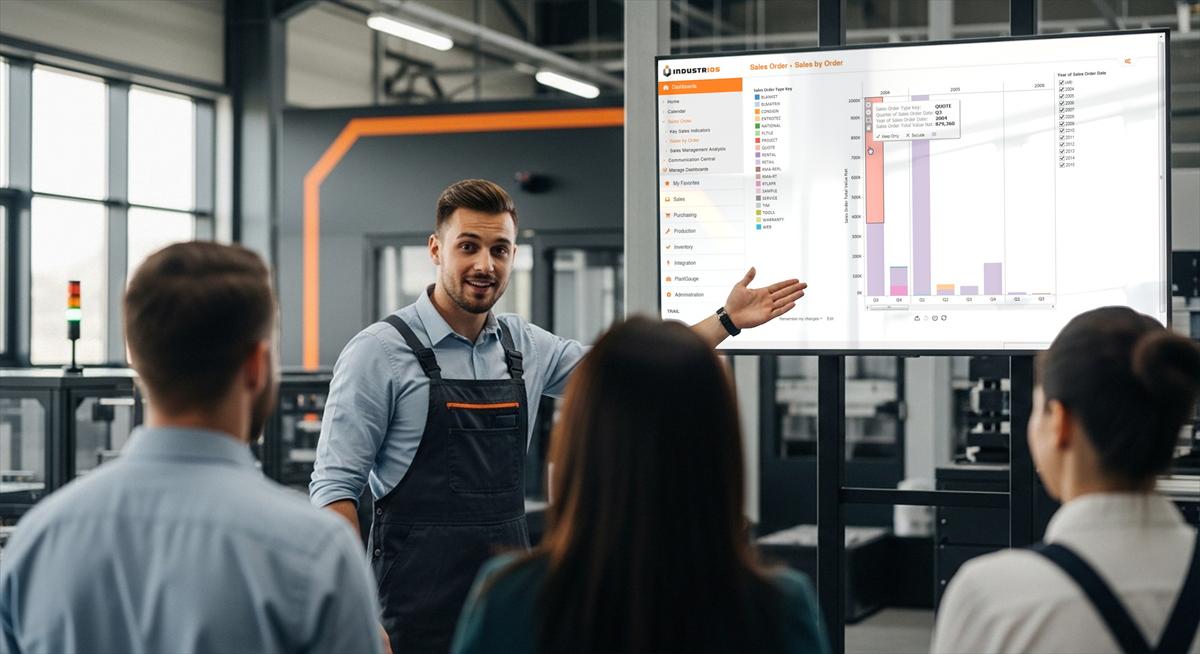
IndustriOS ERP delivers data in a live, interactive format rather than relying on static reports, and the IQ Hub provides one-click access to vital metrics with support for custom queries and multitasking.
-
Does IndustriOS work with Power BI?
Yes. While IndustriOS includes its own reporting and dashboard tools, some manufacturers want to pull ERP data into Power BI for advanced analytics, cross-system reporting, or executive dashboards that combine manufacturing data with financial or sales data from other sources.
IndustriOS supports Power BI integration for advanced reporting and analytics beyond what the built-in dashboard provides.
-
What is PlantGauge?
PlantGauge is the IndustriOS browser-based manufacturing intelligence dashboard. It takes the large volumes of data that a manufacturing ERP generates (production output, labor hours, material consumption, order status) and presents it visually so that plant managers and team leads can see what matters without digging through menus or running reports. It is designed to turn data into knowledge that drives decisions and keeps teams aligned.
AI & the Future of Manufacturing ERP
-
Is IndustriOS incorporating AI into its ERP?
Yes, and deliberately so. AI capabilities are being explored and integrated into INDUSTRIOS ERP with a focus on where they create genuine value for manufacturers—smarter data, better visibility into production, and workflows that reduce complexity on the shop floor. The approach is considered rather than rushed: building the kind of foundation that keeps pace with where manufacturing software is headed, without disrupting what’s already working for our customers.
-
Will AI change how I use the system day to day?
The goal is the opposite of disruption. Where AI capabilities are introduced into INDUSTRIOS ERP, the intent is to reduce the burden on your team—surfacing better information, supporting faster decisions, and removing steps that currently require manual effort. The system you know stays intact; AI works underneath it to make it more useful.
-
Do I need to understand AI to get value from IndustriOS ERP?
No. AI is being built into the platform at the level where it makes the software work better—not as a separate tool your team needs to learn or configure. The value shows up in the outcomes: more accurate data, cleaner workflows, and better visibility into your operation. You don’t need to think about how it works to benefit from it.
Quality Management

-
How does quality management connect to manufacturing ERP?
Quality management in manufacturing covers everything from incoming inspection and in-process checks to final inspection, non-conformance tracking, corrective actions, and audit readiness. When quality management software is connected to your ERP, quality events are tied directly to the jobs, parts, and suppliers involved, giving you traceability and trend data you can’t get from a standalone quality system.
IndustriOS integrates with uniPoint Quality Management Software, which offers 25 modules for quality and compliance management, creating a collaborative and paperless environment for continual improvement.